Case Study
Introduction
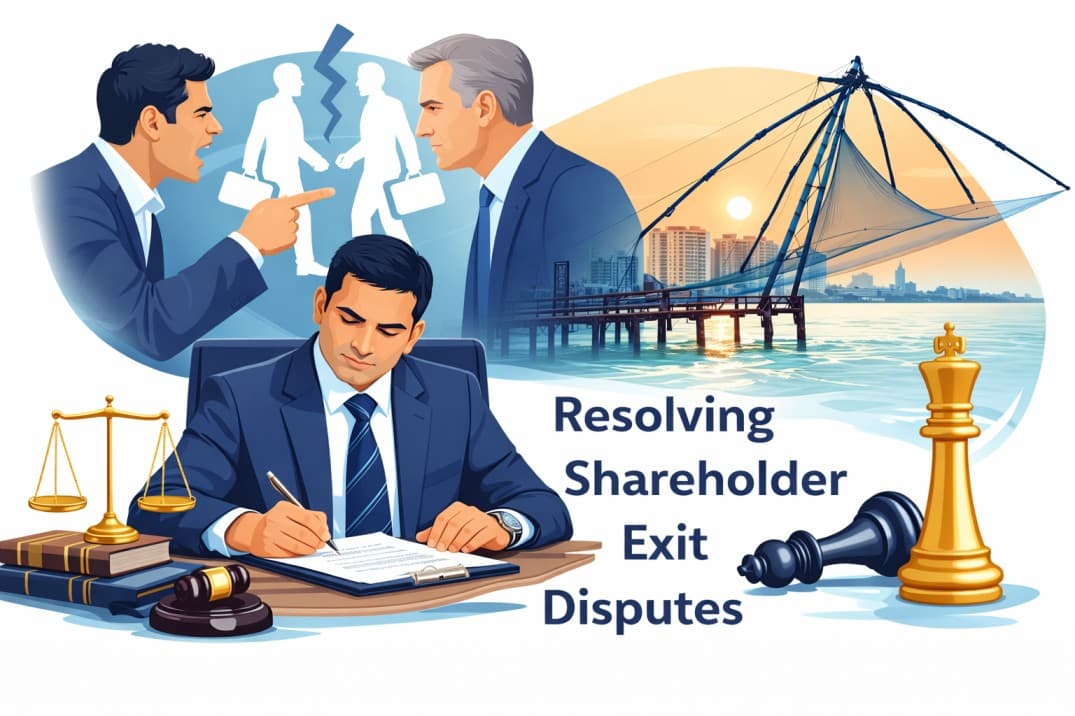
As companies grow, differences between shareholders can become more visible and harder to manage. A legal guidance on shareholder and ownership documentation terms is good to keep in mind. What once started as a shared ambition can gradually turn into disagreement over ownership, valuation, and the long-term direction of the business. In Kochi’s evolving commercial environment, these situations often escalate into formal exit disputes that can create uncertainty for the entire organization.
This is where Corporate Lawyer guidance becomes important, helping bring structure to what is often a complex and sensitive situation. By using commercial arbitration mechanisms and a dispute litigation lawyer, such disputes can be managed. This case study explains how a dispute resolution law firm approached a challenging shareholder exit matter with a structured and balanced resolution strategy.
Case Overview
Shareholder Dispute Context in Kochi’s Business Landscape
The company in question was a mid-sized, innovation-driven enterprise headquartered in Kochi. Founded by three shareholders, the organization experienced rapid growth, expanded into international markets, and attracted institutional investment. Despite its success, internal alignment began to weaken over time.
A Corporate Lawyer was engaged early when disagreements intensified around business direction. While one shareholder pushed for aggressive reinvestment, others preferred financial consolidation. These differences gradually escalated into a formal dispute, requiring intervention from a dispute resolution law firm.
Triggering Events Leading to Exit Conflict
The conflict reached a critical stage when one shareholder decided to exit the business. This decision marked a turning point and formalized the dispute. The exiting shareholder proposed selling their stake at a much higher valuation. The remaining stakeholders did not agree with this valuation.
The disagreement centered on interpreting valuation clauses within the shareholders’ agreement. A Corporate Lawyer reviewed the agreement and identified ambiguities in defining fair market value. This led to the activation of a structured arbitration clause. A corporate arbitration attorney and a dispute litigation lawyer were engaged to manage the process effectively.
Impact of the Issue
Operational Risks Managed by a dispute litigation lawyer
The dispute created operational instability, with delays in decision-making and execution. A Corporate Lawyer worked closely to ensure that the conflict did not disrupt daily operations or client commitments. This intervention helped maintain continuity in critical business functions during the dispute period.
Financial Uncertainty and Role of dispute resolution firms
Investor confidence was affected due to uncertainty in ownership structure. Communication with stakeholders became inconsistent and cautious. This created hesitation in ongoing and future funding discussions. The situation increased perceived financial risk and reduced overall market confidence.
Governance Breakdown and commercial arbitration Challenges
Board-level disagreements intensified, affecting governance processes. The absence of clarity in contractual provisions made structured arbitration both necessary and complex. A Corporate Lawyer ensured that governance risks were mitigated while arbitration proceedings were structured efficiently.
Solution Offered by TGC Legal
Strategic Legal Assessment by a corporate arbitration attorney
A Corporate Lawyer led a comprehensive review of all legal and financial documents. Working alongside an arbitration attorney, the legal team developed a strategy that aligned with both contractual obligations and business priorities. This assessment helped identify key contractual ambiguities that influenced the dispute direction.
Structuring commercial arbitration for Efficient Resolution
The Corporate Lawyer initiated structured arbitration proceedings as defined in the shareholders’ agreement. Arbitrators with expertise in corporate finance were appointed to ensure a fair evaluation of the dispute. This ensured that the dispute followed a legally enforceable and structured resolution pathway.
Negotiation Framework Guided by dispute resolution law firm
Parallel to arbitration, the dispute resolution law firm facilitated structured negotiations. The Corporate Lawyer ensured that discussions remained productive and aligned with legal frameworks, reducing the risk of prolonged conflict. This parallel approach helped maintain momentum toward a potential settlement.
Valuation Process by corporate arbitration attorney
Independent valuation experts were appointed to determine fair market value. The Corporate Lawyer and arbitration attorney ensured that methodologies such as discounted cash flow and market comparables were applied consistently. This created transparency and reduced disagreement over financial assumptions.
Risk Mitigation Led by dispute litigation lawyer
To safeguard business continuity, a dispute litigation lawyer implemented interim protections. The Corporate Lawyer ensured that no unilateral decisions affected the company during the dispute period. This helped maintain operational stability throughout the arbitration process.
Outcome
Resolution Achieved Through commercial arbitration Framework
The dispute was resolved through a combination of negotiation and structured arbitration. The Corporate Lawyer played a key role in aligning both parties toward a mutually acceptable outcome. The structured process ensured reduced escalation risk and faster convergence on settlement terms.
Legally Binding Settlement with dispute resolution firms Support
The final agreement was formalized as an arbitration award, ensuring enforceability. The involvement of dispute resolution firms strengthened the legal robustness of the settlement. This provided legal finality and eliminated the possibility of reopening the dispute.
Business Continuity Restored with Corporate Lawyer Guidance
Post-resolution, the company regained operational stability. The Corporate Lawyer continued to advise on governance improvements and strategic alignment. This helped restore internal confidence and normalized business decision-making processes.
Strengthened Governance with corporate arbitration attorney Insights
The legal team, including the arbitration attorney, helped revise the shareholders’ agreement to eliminate ambiguities and prevent future disputes. This reinforced long-term governance clarity and reduced future legal exposure.
Conclusion
This case study demonstrates how a Corporate Lawyer, supported by a dispute resolution law firm, can effectively manage complex shareholder exit disputes with precision and strategic clarity. The integration of structured legal processes with commercial understanding ensures that disputes are contained early, reducing operational disruption and maintaining organizational stability.
Commercial arbitration continues to serve as a reliable and confidential mechanism for resolving high-value corporate conflicts. It ensures that disputes are addressed in a structured legal framework while protecting both contractual rights and commercial interests. This approach helps prevent escalation into prolonged litigation and preserves overall business value.
FAQ
1. What does a Corporate Lawyer do in shareholder exit disputes?
A Corporate Lawyer helps interpret shareholder agreements, manage negotiations, and guide disputes into structured legal resolution processes. They ensure that exits are handled in compliance with contractual and statutory requirements.
2. When should a Corporate Lawyer be involved in a shareholder conflict?
A Corporate Lawyer should be involved as soon as disagreements arise over ownership, valuation, or control to prevent escalation and protect business continuity.
3. What causes shareholder exit disputes in growing companies?
Shareholder exit disputes often arise due to differences in valuation expectations, strategic direction, governance control, or unclear exit clauses in shareholder agreements.
4. How does a structured arbitration process help resolve disputes?
A structured arbitration process provides a legally enforceable and neutral framework to resolve conflicts without prolonged court litigation, ensuring faster and confidential outcomes.
5. What role does a corporate arbitration attorney play in such cases?
A corporate arbitration attorney represents parties during arbitration proceedings, ensuring that evidence, valuation, and contractual interpretations are effectively presented.
6. Why is a dispute litigation lawyer important during shareholder exits?
A dispute litigation lawyer safeguards legal rights during escalations, handles court interventions if required, and ensures interim protections for business continuity.
7. How do dispute resolution law firms assist in shareholder conflicts?
Dispute resolution law firms provide end-to-end support, including legal strategy, negotiation facilitation, arbitration representation, and settlement structuring.
8. Can shareholder exit disputes be resolved without litigation?
Yes, most disputes can be resolved through negotiation or arbitration-based mechanisms, avoiding lengthy and costly court proceedings.
9. How is valuation handled in shareholder exit disputes?
Valuation is typically determined through independent financial experts using methods such as discounted cash flow analysis, market comparables, and agreed contractual formulas.
10. What are the benefits of resolving disputes through arbitration?
Arbitration offers confidentiality, enforceability, faster resolution, and reduced disruption to business operations compared to traditional litigation.